

West Coast Chipmaker Inc. (name changed) is a medium sized manufacturing outfit doing contract manufacturing mainly for the machine tool makers, the aerospace industry and some prototyping. They have 12 CNCs (milling, mill-turn, lathe), lot size range from 10 – 100 pieces. West Coast competes on time and precision, making changeovers a bottleneck. Short chip-to chip times are crucial for WestCoast’s competitiveness.
Each of West Coast’s three manufacturing/CAM engineers have at least one job to set up per day. More often than not, they need tools that are not at hand. Even if the engineer has an idea knows what type of tool she wants to use, e.g. a Ø 0,5 inch solid carbide milling cutter long enough to reach a deep pocket, what would she do? Well, start working: Searching by the dimensions in tool catalogs, both in print and online. Once she finds what might fit her needs, she
She’s quick, so it only takes her about 20 minutes per item.
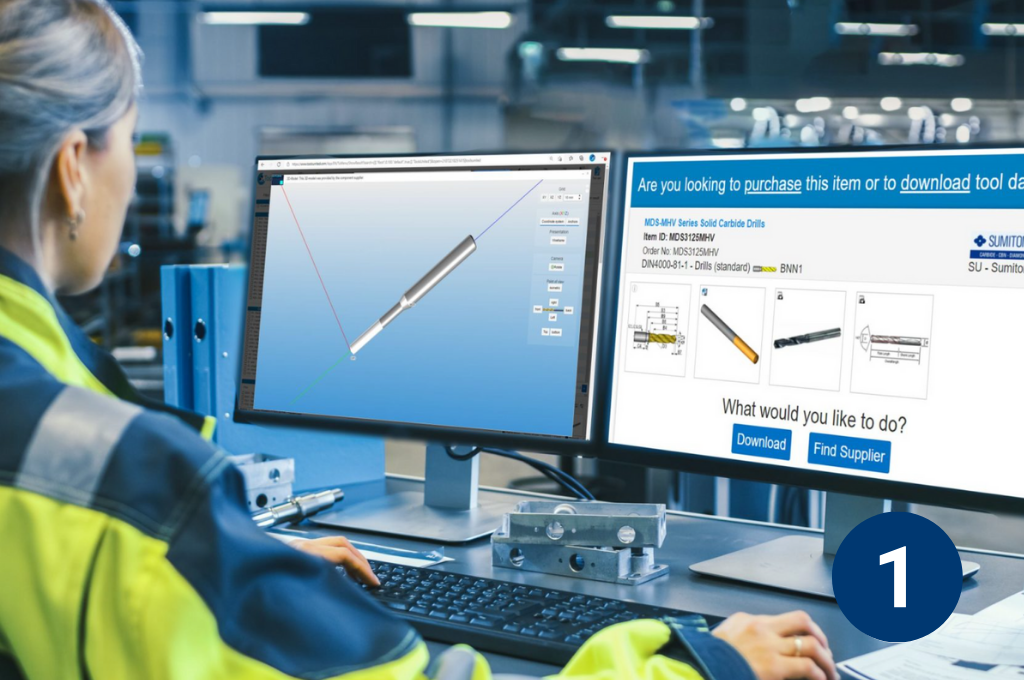
That’s no fun. But hey: it’s the digital age. Let’s “google” the item! She get’s a first-class hit at ToolsUnited. The item is displayed with a click of the mouse and all properties are clearly displayed. Copy and paste with two more mouse clicks and she’s done. It takes less than 5 minutes per item. That’s an incredible time saving of 75%! She only needs 8 items today. It still saves 2 hours today!
“My personal time”, she thinks. “Quality time I can reinvest into actual engineering work, process optimization, or reducing my engineering backlog”.
Thank you, ToolsUnited!
But ToolsUnited goes beyond simple tool search. West Coast became a “registered” user. ToolsUnited provides a personal workspace, the “own tools” section, where West Coast stores all tools for repetitive use. This personal “tool cloud” became the foundation West Coast’s company-wide tool database. All of West Coast’s CAM engineers now work from the same standardized toolset. Being freed from annoying search and typing task, the fun of working at West Coast has increased significantly. But does it make the boss happy? The ROI of the ToolsUnited invest (if you call $3,200 an invest at all) was less than 20 days! What more could you ask for?
West Coast Chipmaker Inc. (name changed) with it’s 12 CNCs (milling, mill-turn, lathe) and small lot sizes from 10 – 100 pieces has been looking for tools on ToolsUnited for over 2 years now. They liked the “own tools” section that is provided for each registered user. The CAM-engineers copy all the tools they use in the workshop into this special section. That was West Coast’s starting point for a tooling database as a single source of truth for all process engineers.
But: “I like my ToolsUnited so much, if only it had all the tools I need”, muses the CAM engineer who discovered ToolsUnited for WestCoast. 1,2 million SKU’s on ToolsUnited is impressive, but still: There’s always something missing. A property, an item, or the product range of one of our suppliers altogether. The engineer knows that she can up-load a list of tool item no. to ToolsUnited so as to create a batch download for the required data. ToolsUnited creates a report of what was and what wasn’t found. And now what?
“I want to forward that list of missing items to the respective supplier”, thinks the engineer. And here is what came back from the ToolsUnited tech support:
“We up-graded your account to include the data gathering and clean up features”.
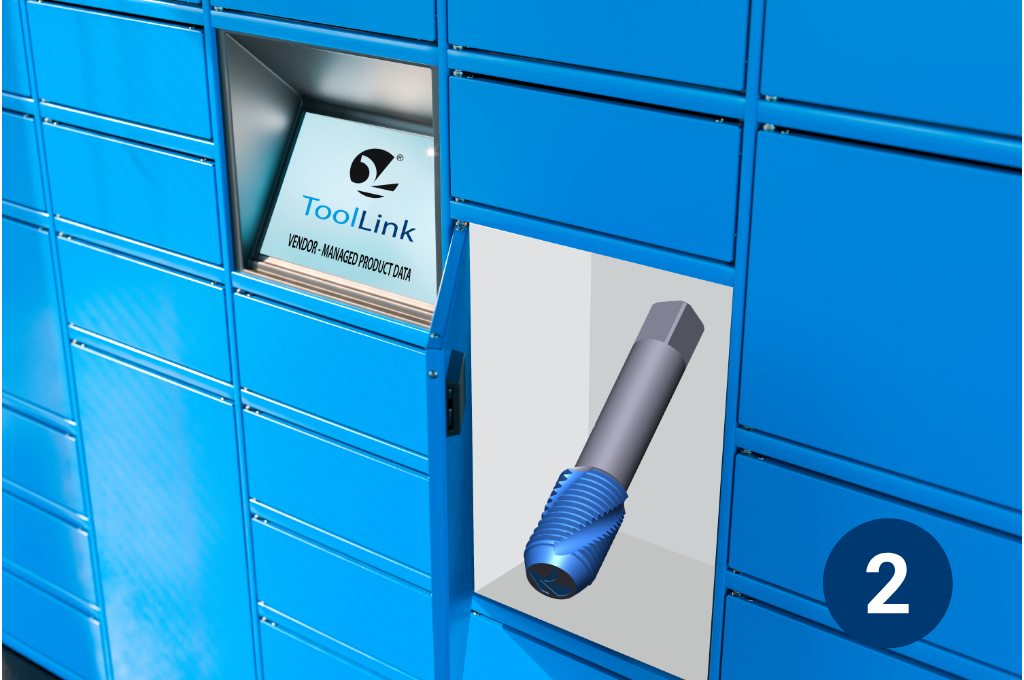
What a sensation! If I now do the same upload of all the item numbers I need, ToolsUnited not only returns what is readily available in ToolsUnited. But for items that it can’t find, it sends a request to the supplier. The request includes access credentials to West Coast’s “myToolsUnited” account so that they see exactly what I’m looking for. Each tool and each property clearly spect out. Now I just have to wait for the supplier to reply. And why should the supplier object? All I’m asking for is tool data in a standard format.
The lead time for data collection and cleansing has been reduced by 50%. Reportedly it took the CAM engineer 2 – 8 hours to track an item that was not in ToolsUnited. Now there’s no more catalog crawling, no endless emails. Just clean, fast, digital cooperation.
With an average of 4 hours saved per missing item we saved 1,600 hours for the 400 items I needed. That adds up to $60,000 saved.
Best of all: West Coast’ tool database provides 100% of all data! That’s what the boss likes.
West Coast Chipmaker Inc. (name changed) after 3 years of working with ToolsUnited now has 3,500 tool assemblies and nearly the same amount of single items in the tooling database. “That’s weird”, wonders CAM engineer Laura, “doesn’t sound like standard. Do we build every tool assembly from scratch?” That’s alarming, because redundant items will result in hidden cost. Why?
Fragmented purchasing,
overstocked shelves and
confusion about what to use.
CAM engineer Laura starts to investigate. “How many 0,5 inch drills are in our inventory? How can I say exactly which one is used for which job?” She starts to run through the process plans to find the relation of each tool assembly to the workpieces it is applied and to the machines on which it operates. A relation between product, process and resources. “Wait a minute! PPR-relation, isn’t that a term used in the context of ToolsUnited?”
Time for another up-grade. The engineering module extents the database beyond tools to include the CNCs and the workpieces. It helps to establish the required relationships between these objects. With a clear view of the Product–Process–Resource relationships, Laura now can:
Run a smart “where-used” analysis for each tool
Identify obsolete and redundant tools
Consolidate the tooling inventory to fewer items
Improve purchasing leverage with fewer, preferred suppliers
No more confusion”. “When I set up a machine, I find out which tools I need for each workpiece and calculate all the speeds and feeds. And I store this information for later reference. I make sure I don’t miss anything if a colleague of mine has already done a similar setup “Each CAM engineer uses the the same ToolsUnited account.
What a drive for standardization!
WestCoast has reduced the number of items we use by 20%. That means a significant reduction in tool expenditure. At West Coast is was easily 10%.of the annual tool spent of $50,000 per CNC. That’s 60,000 dollars for that year! Only for that year?
Most likely yes, because “weeding through the tool inventory is like going to the hairdresser. You have to do it once in while”.
All machining processes of West Coast Chipmaker Inc. (name changed) are specified in relation to the 12 CNC machine they use, the great variety workpieces they manufacture and of course the tools. This incredibly powerful database has boosted engineering efficiency a great deal. But there’s one thing left for Laura the CAM engineer to learn: Industrial engineers are not the center of the world.
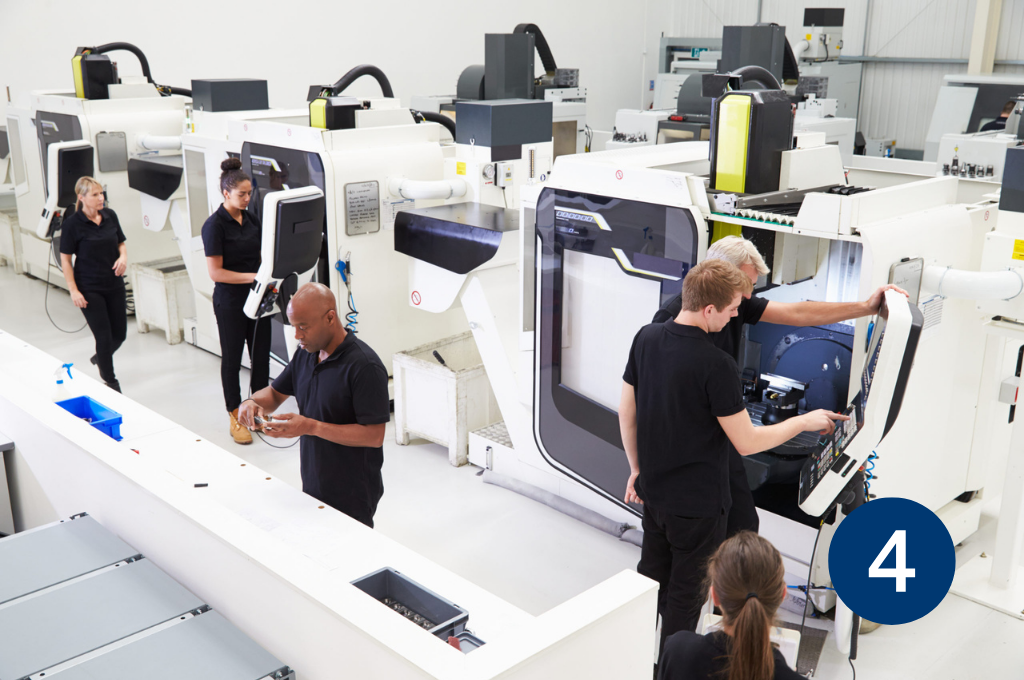
Hey, who runs the CNCs ? Who runs the tool crib? That’s right! Somebody has to bring the tools to the shop floor, build the tool assemblies in real life and physically set up the CNC machines. “My biggest challenge are stock outs”, complains the crib manager. “Laura, however well your team engineers a process, if we don’t have the tools at hand or can’t find the tool components we need in time, the CNC will be idle”. Tell me how do we keep track of the tool assemblies and the related tool items (even if we have cut those down by 20% to “only” 1,800) shuttling back and forth between the tool crib and 12 CNC machines?
“Not my job”, says Laura the CAM engineer. But then again: “What does it take for our database to not only see the tool types we use, but also how many we have of each item, in which condition they are and where they are located?”
Not much: Just a “logistics level” to add tool storage locations. And of course the ability to handle tool instances, not just tool types. So that you can tell: “Of this 0,5 inch milling cutter we have a total of 100 pieces, 60 in the tool crib, 5 at the “Mazak”, 35 in cutter grind”.
Can ToolsUnited do that? Absolutely, there’s a shop floor and procurement module available. West Coast agreed to the final up-grade. Was it worth it?
Well, as a direct consequence of the up-front engineering work the tool inventory has been reduced by 30%. More importantly, however, machine downtimes due to stock outs and faulty set ups tools were reduced by 9% in the first year alone. Doesn’t sound like much? West Coasts CNCs are scheduled to run 2,000 hours a year. Idle time due to missing/faulty tools averaged 18% per machine. And that was cut by more than 50%. 360 hours/machine per year, with West Coast hourly rate of $ 190 that $ 68,400 worth of manufacturing capacity for each machine!
What began three years ago as a Tool Engineer’s journey became the biggest productivity boost in West Coast’s history. In retrospect, clearly a no-brainer for the management to decide. Ask yourself: Why are we different?